


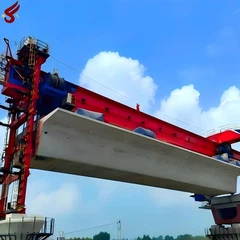
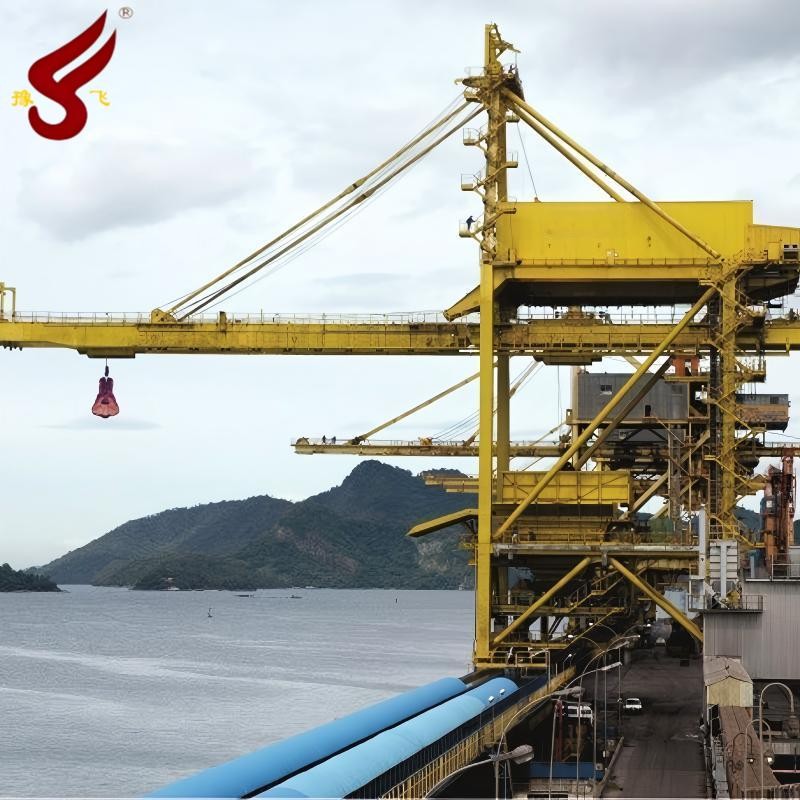
A Quayside Container Crane(also known as a Quay Container Crane or a Ship-to-Shore Container Crane), is a dedicated, fixed-type large crane used at the forefront of modern container terminals for loading and unloading container ships. It typically runs along tracks parallel to the wharf shoreline and is the core equipment for port container operations.
Main Structure and Functions of the Quayside Container Crane
Gantry and Legs: A large steel structure frame that spans the wharf tracks. The lower space allows for the passage of container trucks.
Main Girder (Bridge): A box-type girder spanning above the gantry, serving as the track for the hoisting trolley.
Front Boom (Sea-side Cantilever): A long, luffing arm extending towards the sea. It is lowered during operation to cover the ship's holds and raised when not in use or during movement to avoid the ship's superstructure.
Rear Boom (Land-side Cantilever): A structure extending towards the rear of the wharf, used to counterbalance the weight of the front boom and house equipment like the hoisting mechanism.
Hoisting Mechanism: Consists of high-power motors, wire ropes, and drums, providing the power to lift or lower containers.
Hoisting Trolley: Equipment that travels back and forth on the main girder tracks, carrying the hoisting mechanism and spreader. It is responsible for moving containers from the sea side to the land side, or vice versa.
Telescopic Spreader: A dedicated tool suspended below the trolley for grabbing containers. It extends and retracts via a hydraulic device to automatically lock onto or release containers of different sizes (20ft, 40ft, 45ft, etc.).
Driving Bogies and Wheels: Complete sets of devices installed at the base of each leg, driven by motors, enabling the entire crane to travel on dedicated tracks laid at the wharf front to align with different ship hatches.
Drive and Control System: Includes main power supply, frequency converters, PLCs (Programmable Logic Controllers), etc., controlling the movement, speed, and positioning of the three main mechanisms: hoisting, trolley, and gantry travel.
Safety and Auxiliary Systems: Include various limit switches, overload protection, windproof devices, monitoring systems, etc., to ensure operational safety. Modern cranes are commonly equipped with automatic identification and anti-sway systems that can automatically identify container numbers and reduce spreader swing in the air, improving operational efficiency and safety.
Workflow of the Quayside Container Crane
Unloading Operation: The crane moves to above the target hatch on the ship as instructed -> the spreader descends and locks onto a container on the ship -> it hoists and simultaneously moves towards the land side -> places the container accurately onto a waiting truck or transfer platform.
Loading Operation: The process is reversed, grabbing a container from land-side transport -> hoisting and moving towards the sea side -> accurately placing it into the designated slot on the ship.
Main Characteristics of the Quayside Container Crane
Dedication: Specifically designed for containers, using standard container spreaders for operation.
Large Size: To cover large vessels, its front boom extending seaward can be over 70 meters long.
High Efficiency: Fast loading/unloading speed, typically handling 30 to 60 containers per hour.
High Degree of Automation: Equipped with automatic anti-sway, positioning, and container number identification systems, enabling remote or fully automatic operation.
High Reliability: Designed for long service life, capable of withstanding high-frequency operations, salt spray corrosion, and wind loads, with high safety factors.
Main Applications of the Quayside Container Crane
Container Terminal Front: Loading and unloading container ships.
This is its core and sole function. It moves along the wharf tracks, unloading containers from arriving ships or loading containers stacked on the wharf onto ships.
Large Specialized Container Hub Ports: Handling ultra-large container ships.
At major shipping lanes and hub ports, large cranes are specifically designed to load and unload ultra-large container ships with capacities exceeding 20,000 TEUs, meeting their massive handling demands.
Automated Container Terminals: Serving as the execution terminal for fully automated handling systems.
In automated terminals, the crane connects to a central control system, can automatically execute loading/unloading instructions, and coordinates with equipment like unmanned container trucks to achieve fully unmanned operations.
Sea-Land Intermodal Transfer Point: Facilitating the transfer of containers between ships and land transport vehicles.
The crane is the key physical transfer point between sea transport (ships) and land transport (container trucks, inland trains), directly determining the efficiency and speed of port collection and distribution.
As a professional crane manufacturer in China, YuFei Crane is a comprehensive industrial enterprise that integrates the entire process of material handling equipment, including design, production, sales, installation, and service.
With over 3,000 employees, YuFei Crane has more than 500 management and technical personnel, including over 100 senior engineers. Our factory covers an area of more than 200,000 square meters.
YuFei Crane operates with a first-class quality assurance system, a comprehensive and rigorous management system, robust production capacity, and advanced inspection methods to ensure the high quality of both products and output.
If you have any questions about Quayside Container Cranes, please feel free to contact us at any time.