


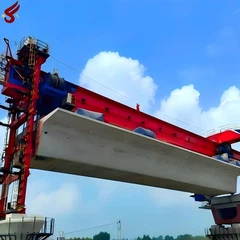
A floating crane is a lifting device installed on a floating vessel. It can be regarded as a mobile lifting platform on water, specifically used for various lifting operations on water. Its main purposes can be summarized into five aspects: port and dock loading/unloading, bridge construction and large component installation, marine rescue and salvage operations, offshore engineering and energy development, and shipbuilding and related operations.
I. Port and Dock Loading/Unloading
Floating cranes can perform cargo loading and unloading operations between ship and shore, and between ship and ship. They are not restricted by the bearing capacity of the dock ground, can be flexibly transferred between different docks, and have a high utilization rate. According to the nature of operation, they can be divided into two types:
Loading/unloading type (general purpose type): Mainly used in inland river and coastal ports to handle bulk cargo, general cargo, coal, sand, etc. This type of crane is usually capable of 360-degree rotation, has a high working speed, and can meet productivity requirements.
Lifting type (heavy-duty type): Specifically used for lifting heavy and large components. It does not require high productivity, but has a large hoisting height and large lifting capacity, meeting the lifting requirements of special working conditions.
II. Bridge Construction and Large Component Installation
Floating cranes play an important role in overwater bridge construction, especially suitable for the construction of large cross-sea and cross-river bridges. They are mainly responsible for:
Lifting large bridge components such as steel box girders and steel truss girders;
Precisely placing cofferdams, bridge piers and other structures in deep water areas.
III. Marine Rescue and Salvage Operations
Floating cranes are core equipment for marine emergency rescue and underwater salvage, capable of integrally lifting large-tonnage underwater objects. The main uses include:
Salvaging sunken ships and sunken objects;
Performing underwater clearance operations to ensure navigable waterway and port access;
Carrying out emergency rescue tasks during incidents.
IV. Offshore Engineering and Energy Development
With the continuous advancement of marine resource development, the application of floating cranes in the offshore engineering field is becoming increasingly extensive:
Offshore wind farm construction: Responsible for the transport and installation of wind turbine foundations (monopiles, jackets, etc.), wind turbine towers, units, and blades.
Offshore oil and gas platform construction: Used for the installation and dismantling of large structures such as drilling platforms, jackets, and topsides, as well as seabed energy development operations.
V. Shipbuilding and Related Operations
In shipyards and overwater work sites, floating cranes are widely used for ship outfitting, repair, and equipment lifting operations, including hoisting small boats, handling large mechanical equipment, etc.
VI. Other Applications
Floating cranes can also be used for port construction in hydraulic engineering, lifting operations in water conservancy projects, and dredging, sand unloading, and coal unloading during waterway and port dredging. In recent years, some floating cranes have been deeply integrated with excavation machinery, enabling underwater excavation, underwater cutting, and other comprehensive construction operations.

Classification Overview
|
Classification Dimension |
Type |
Main Characteristics and Applicable Scenarios |
|
Mobility |
Self-propelled |
Equipped with its own power unit, capable of independent navigation, good maneuverability, flexible operation |
|
Non-self-propelled |
No autonomous navigation capability, requires towboat towing or towing, commonly used for operations in fixed waters |
|
|
Slewing Performance |
Full-revolving |
Crane can rotate 360 degrees, wide application range, adopted by small/medium and some large floating cranes |
|
Non-revolving |
Crane is fixed or can only rotate within a small range, simple structure, large lifting capacity, commonly used for heavy operations such as salvage of sunken ships |
Floating cranes have a wide range of applications, from port loading/unloading to bridge construction, from sunken ship salvage to offshore energy development. Wherever lifting operations on water are required, this equipment is indispensable.
As a professional crane manufacturer in China, YuFei Crane is a comprehensive industrial enterprise that integrates the entire process of material handling equipment, including design, production, sales, installation, and service.
With over 3,000 employees, YuFei Crane has more than 500 management and technical personnel, including over 100 senior engineers. Our factory covers an area of more than 200,000 square meters.
YuFei Crane operates with a first-class quality assurance system, a comprehensive and rigorous management system, robust production capacity, and advanced inspection methods to ensure the high quality of both products and output.
If you have any questions about Floating cranes, please feel free to contact us at any time.