


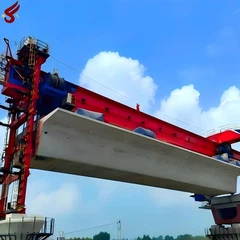
1. What is a single-girder gantry crane? What is a double-girder gantry crane?
1.1 Single-Girder Gantry Crane
A single-girder gantry crane uses a single main beam as the load-bearing body, supported at both ends by legs running on ground rails. The hoisting mechanism is typically a wire rope electric hoist, which is suspended from the lower flange of the main girder and travels along it. The overall structure is simple and the self-weight is light, making it a light- to medium-duty lifting device.
In standard configurations, the rated lifting capacity of a single-girder gantry crane covers 1–32 tons, with a work duty class mostly between A3 and A5, suitable for light-load, low-frequency operations. The main girder structure can be either a box girder or a truss girder: box girders provide good rigidity and are suitable for indoor use; truss girders have lighter self-weight and better wind resistance, making them more suitable for outdoor, large-span scenarios.
1.2 Double-Girder Gantry Crane
A double-girder gantry crane consists of a load-bearing frame formed by two parallel main girders, with typically reinforced leg structures. The hoisting trolley runs on rails mounted on top of the two main girders. The structure offers high rigidity and strong resistance to eccentric loads, classifying it as a medium- to heavy-duty lifting device.
The rated lifting capacity of a double-girder gantry crane covers 5–500 tons and above, with a work duty class reaching A3–A7, meeting heavy-load, high-frequency operation requirements. Depending on the application, it can be configured with main and auxiliary hooks, grabs, electromagnetic lifting magnets, and other various lifting attachments. It also supports upgraded functions such as cabin operation and anti-sway systems.
2. Single-Girder vs. Double-Girder Gantry Crane: Comprehensive Comparison Across 7 Core Dimensions
| Comparison Dimension | Single-Girder Gantry Crane | Double-Girder Gantry Crane |
|---|---|---|
| Structural Form | Single main girder + electric hoist running suspended below | Double main girder frame + hoisting trolley running on top |
| Rated Lifting Capacity | Typically 1–32t, maximum not exceeding 50t | Typically 5–500t, can be customized for larger capacities |
| Lifting Height & Clearance | Hoist occupies clearance below; effective lifting height is smaller for the same building height | Trolley runs on top of main girders, not occupying space below; provides greater effective lifting height |
| Work Duty Class | Mostly A3–A5, suitable for ≤4 hours of operation per day | Can reach A3–A7, supports continuous high-frequency operation over 8 hours |
| Procurement Cost | 25%–40% lower than double-girder for the same parameters | Higher steel consumption, 30%–50% higher cost than single-girder for the same tonnage |
| Installation & Maintenance | Fewer components, light self-weight, short installation cycle, easy maintenance | Complex structure, higher requirements for foundation bearing capacity, more maintenance items |
| Site Adaptability | Lower overall height, suitable for sites with height restrictions and average foundation conditions | Greater overall height, requires spacious site with adequate ground bearing capacity |
2.1 Differences in Structural Stress and Stability
A single-girder gantry crane is a single-beam bending structure, with loads concentrated on the lower flange of the main girder. Its lateral wind resistance is relatively weak, and it is prone to sway during long-span operation. A double-girder gantry crane forms a symmetrical load-bearing frame with two girders, distributing the load evenly across both main girders. Its overall rigidity is 2–3 times that of a single-girder crane of the same tonnage, providing stronger resistance to eccentric loads and wind, and better stability for outdoor operations.
2.2 Differences in Total Cost of Ownership (TCO)
Many buyers focus only on the initial procurement price. In reality, the long-term operating cost of a double-girder crane is often better. Although a single-girder unit has a lower purchase price, it wears out faster under heavy-duty conditions, potentially requiring main girder replacement within 5–8 years. Double-girder equipment generally has a design life of 15–20 years, higher work efficiency, and is suitable for long-term factory sites with stable production. For short-term projects (≤3 years), a single-girder is more economical; for permanent, long-term factory sites (≥5 years), a double-girder offers a lower total cost of ownership.
3. Advantages and Applicable Scenarios of Single-Girder Gantry Cranes
3.1 Core Advantages
Outstanding Cost-Effectiveness: Less steel consumption and a simpler manufacturing process result in significantly lower procurement costs compared to double-girder cranes. Its light self-weight also means lower requirements for rail and ground foundations, potentially saving over 20% on civil construction costs.
Fast Installation and Deployment: With fewer components, on-site installation can take as little as 3–5 days, enabling rapid commissioning-ideal for temporary projects with tight schedules.
Space-Friendly: The overall equipment height is low, with minimal requirements for factory or site headroom, making it the preferred solution for height-restricted locations.
3.2 Applicable Scenarios
Loading and unloading of loose cargo in small to medium-sized warehouses and building material yards.
Material handling in light manufacturing and hardware processing workshops.
Auxiliary lifting for temporary construction sites and small prefabrication yards.
Work scenarios with limited budgets and low operating frequency.
4. Advantages and Applicable Scenarios of Double-Girder Gantry Cranes
4.1 Core Advantages
Strong Load Capacity: The double-girder structure can withstand large-tonnage and long-span loads. It supports coordinated operation of main and auxiliary hooks, allowing for complex lifting actions such as flipping and precise positioning.
Excellent Expandability: It can be equipped with operator cabins, maintenance walkways, anti-sway systems, and remote monitoring, meeting the requirements for automated and intelligent production upgrades.
Long Service Life: High structural redundancy ensures stable performance under high-frequency, heavy-duty conditions, resulting in a longer overall equipment lifecycle.
4.2 Applicable Scenarios
Lifting heavy components in precast beam yards and steel structure plants.
High-frequency loading and unloading operations in ports and scrap processing yards.
Production and assembly in heavy machinery and shipbuilding industries.
Large industrial facilities with high demands for operational efficiency and safety.
|
|
|


5. Selection Decision Guide: 5 Steps to Determine Which Type to Choose
You don't need to struggle with detailed parameters. Simply check the following five dimensions one by one to reach a quick conclusion:
Check Rated Lifting Capacity: ≤20 tons and no eccentric load requirements? Prioritize single-girder. ≥20 tons, or if there's a capacity expansion plan within the next 3 years? Opt for double-girder.
Check Working Intensity: ≤4 hours of intermittent daily use? Choose single-girder. 8 hours of continuous, frequent lifting daily? Choose double-girder.
Check Site Conditions: Limited headroom, weak ground bearing capacity, or temporary site? Select single-girder. Spacious site, adequate foundation conditions, and permanent factory setting? Select double-girder.
Check Functional Requirements: Only need simple hook lifting and transport? Choose single-girder. Need multiple lifting attachments, operator cabin, precise positioning, or future automation upgrades? Choose double-girder.
Check Project Duration: Short-term project with ≤3 years usage? Prioritize single-girder for cost control. Permanent facility with ≥5 years usage? Prioritize double-girder for long-term reliability.
Tip: If you are at borderline parameters (e.g., 16 tons, 5 hours of daily operation), it is recommended to choose the double-girder. Reserving a 20% capacity margin in crane selection is a general principle to avoid future failures and extend service life.
6. Frequently Asked Questions (FAQ)
Q1: Should I choose a single-girder or double-girder for a 10-ton gantry crane?
For an ordinary open-air warehouse or building material yard with no more than 4 hours of operation daily at work duty class A3, a single-girder gantry crane is fully sufficient. For a steel structure plant or scrap yard with frequent operation, eccentric loads, or impact loading, a double-girder is recommended.
Q2: Can a single-girder gantry crane be retrofitted into a double-girder?
Direct retrofitting is not recommended. The leg force design, rail foundation bearing capacity, and traveling mechanism configurations are completely different. The cost of retrofitting approaches that of purchasing new equipment, and the structural safety performance cannot pass formal inspection, posing a significant safety hazard.
Q3: How to choose between a truss girder and a box girder?
For outdoor scenarios with large spans and strong winds, prioritize a truss girder-it is lighter in self-weight, offers better wind resistance, and has lower transportation costs. For indoor workshops and environments with heavy dust, prioritize a box girder-it has better rigidity, is less prone to dust accumulation, and is simpler for daily maintenance.
Q4: For exporting gantry cranes overseas, is a single-girder or double-girder more cost-effective?
Sea freight is charged by volume and weight. Single-girder equipment is lighter in self-weight and easier to pack into containers after dismantling, resulting in lower logistics costs. For large-tonnage double-girder equipment, shipment is typically done via breakbulk. It is recommended to make a comprehensive judgment considering the destination country's tariff policies and labor costs. We can provide a complete landed cost estimate based on your port of destination.
7. Conclusion
There is no absolute good or bad between single-girder and double-girder gantry cranes-only whether they suit the working conditions. The single-girder is a high-value choice for light-load, low-frequency, and budget-limited scenarios, while the double-girder is the reliable solution for heavy-load, high-frequency, and long-term use.
The core principle of selection is not to pursue the highest possible parameters, but to match current operational needs while reserving capacity for expansion over the next 3–5 years. The downtime losses and safety risks caused by choosing the wrong model far exceed the price difference of the equipment itself.
If you are still unsure which type to choose for your working conditions, please send us your required lifting capacity, span, lifting height, and working environment. Our engineers will provide you with a free selection proposal and detailed quotation.