





Product Introduction
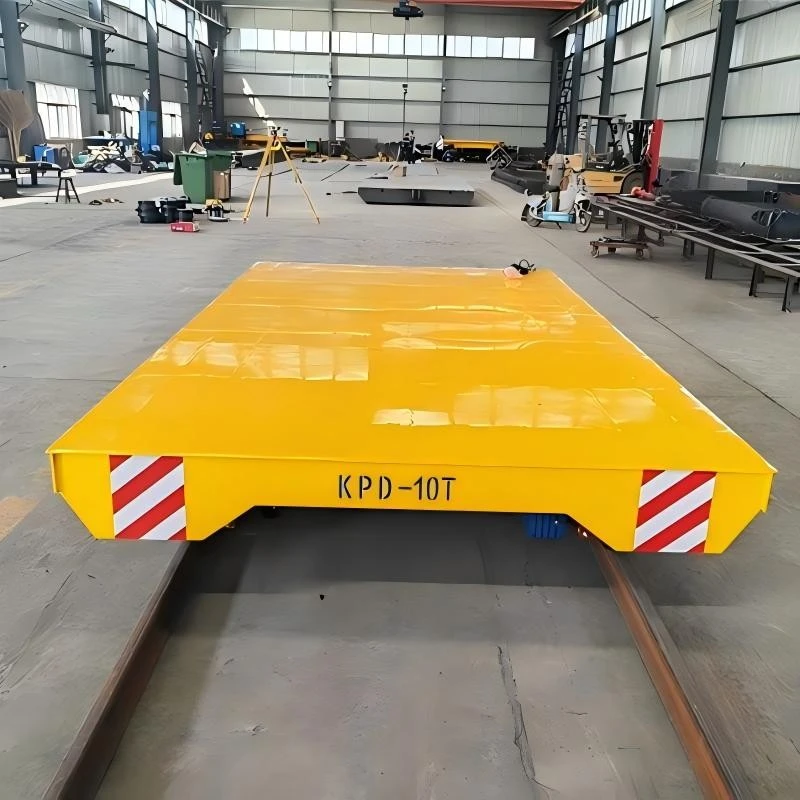
The KPD low-voltage rail powered transfer cart draws power directly from the rails. A ground-mounted step-down transformer converts workshop 380 V AC into 36 V Safety Extra-Low Voltage (SELV). This power is fed into insulated running rails. Sliding current collectors, also called collector shoes, on the wheel sets pick up power from the rails. The power is then fed to the cart's on-board electrical system.
The steel rails serve two functions. They are the running track for the cart. They are also the power conductor. This is why the rails must be insulated from the sleepers and foundation.
How the Low-Voltage Rail Powered Transfer Cart Works?
A control cabinet beside the track steps down the 380 V single-phase or three-phase supply to 36 V AC.
Single-phase KPD uses two rails. Three-phase KPDS uses three rails. The rails are isolated from the sleepers and foundation by insulating pads and an asphalt sealing layer. The steel rails serve both as running rails and as power conductor rails.
Carbon brushes or conductive shoes mounted on the wheel sets collect power continuously while the cart is moving. On the single-phase KPD, the 36 V AC is rectified to DC to drive the transfer cart. On the three-phase KPDS, an on-board step-up transformer restores 380 V AC. The system is equipped with YZ metallurgical hoisting motors.
Power is supplied continuously from the fixed rails. This supports 24/7 uninterrupted operation. It is particularly suitable for working conditions such as rolling lines and foundry shops, where interruptions caused by battery replacement, charging, or cable reeling/unreeling are unacceptable. It is the preferred solution for these applications.
The standard KPD series is a single-phase 36 V version with two insulated rails and a rectified DC drive. It is suitable for small and medium tonnage, with a maximum load of up to 80 t.
For heavy-duty continuous operation above 50 t, the three-phase KPDS version is recommended. It is equipped with three insulated conductor rails and YZ metallurgical hoisting motors.
Technical Specifications
Reference parameters from Yufei Crane, aligned with industry standard ranges. All capacities, dimensions and configurations are custom-designed to your load, route and duty. Transformer capacity is given in kVA. Speeds are given as working ranges.
|
Model |
Rated load (t) |
Deck L×W×H (mm) |
Wheelbase (mm) |
Track gauge (mm) |
Wheel diameter (mm) |
Speed (m/min) |
Motor (kW) |
Step-down transformer (kVA) |
Max. wheel load (kN) |
Reference dead weight (t) |
Recommended rail section |
|
|
KPD-2T |
2 |
2000×1500×450 |
1200 |
1200 |
Ø270 |
0–25 |
0.8 |
3 |
14.4 |
2.8 |
P15 |
|
|
KPD-5T |
5 |
3500×2000×450 |
2500 |
1435 |
Ø300 |
0–25 |
1.5 |
5 |
25.8 |
3.6 |
P18 |
|
|
KPD-10T |
10 |
3600×2000×500 |
2600 |
1435 |
Ø300 |
0–25 |
1.5 |
5 |
42.6 |
4.2 |
P18 |
|
|
KPD-16T |
16 |
4000×2000×500 |
2800 |
1435 |
Ø350 |
0–20 |
2.2 |
6.8 |
64.5 |
5.5 |
P24 |
|
|
KPD-20T |
20 |
4000×2200×550 |
2800 |
1435 |
Ø350 |
0–20 |
2.5 |
6.8 |
77.7 |
5.9 |
P24 |
|
|
KPD-25T |
25 |
4500×2200×600 |
3200 |
1435 |
Ø400 |
0–20 |
3.0 |
6.8 |
94.5 |
6.5 |
P38 |
|
|
KPD-30T |
30 |
4500×2200×600 |
3200 |
1435 |
Ø400 |
0–20 |
4.0 |
10 |
110.4 |
6.8 |
P38 |
|
|
KPD-40T |
40 |
5000×2500×650 |
3800 |
1435 |
Ø500 |
0–20 |
5.5 |
10 |
142.8 |
7.6 |
P43 |
|
|
KPD-50T |
50 |
5500×2500×650 |
4200 |
1435 |
Ø500 |
0–20 |
5.5 |
10 |
174 |
8.0 |
P43 |
|
|
KPD-63T |
63 |
5600×2500×750 |
4300 |
1435 |
Ø600 |
0–20 |
7.5 |
20 |
221.4 |
10.8 |
P50 |
|
|
KPD-80T |
80 |
5600×2500×750 |
4360 |
1435 |
Ø600 |
0–20 |
7.5 |
20 |
278.4 |
12.8 |
P50 |
|
|
KPD-100T |
100 |
6500×2800×850 |
4900 |
2000 |
Ø600 |
0–20 |
11 |
30 |
343.8 |
14.6 |
QU100 |
|
|
KPDS-150T |
150 |
10000×3000×1200 |
7000 |
2000 |
Ø600 (8 wheels) |
0–18 |
15 |
30 |
265.2 |
26.8 |
QU100 |
Rail-side power supply: AC 36 V, stepped down from 380 / 400 / 415 V at 50/60 Hz.
Single-phase KPD runs on two insulated rails. Three-phase KPDS runs on three insulated rails.
Recommended step-down transformer spacing: one unit per 50–70 m of rail (add copper busbar compensation lines for very long distances).
Standard equipment: pendant control + wireless remote control.
Custom designs up to 300 t.
Why Choose a Low-Voltage Rail-Powered (KPD) Transfer Cart?
The KPD low-voltage rail-powered transfer cart shows its greatest advantages on long, fixed routes with continuous heavy-duty operation.
24/7 Continuous Operation with No Charging Downtime
It draws power continuously from insulated rails. There is no battery and no charging. As long as the rails are powered, it can run around the clock. For rolling lines, foundries, and smelting plants, it avoids production interruptions caused by charging or battery replacement. This helps reduce downtime losses.
36 V Safety Extra-Low Voltage for High Safety
The rails carry 36 V SELV. This is a safety extra-low voltage. It is designed in accordance with international electrical safety standards. The entire track is insulated from earth. The system is equipped with a protection control cabinet with earth leakage protection. This reduces the risk of electric shock. It is suitable for dusty, hot, and humid foundry and metallurgy workshops.
Wide Load Range and Stable Heavy-Duty Performance
The standard single-phase KPD transfer cart suits small and medium tonnage. Its maximum load is up to 80 t. The three-phase KPDS transfer cart suits heavy-duty applications above 50 t with high frequency. It offers stronger power and smooth starting. It is equipped with YZ metallurgical hoisting motors. These motors are heat-resistant and impact-resistant. They suit harsh environments in steel plants and hot-working shops.
Long Travel Distance
Battery-powered transfer carts are limited by battery endurance. Cable-reel transfer carts usually suit working distances of about 50–100 m. The low-voltage rail transfer cart does not have this limitation. Power follows the rails. We recommend one step-down transformer set every 50–70 m. Copper bar compensation feeders are added on very long sections. This supports travel distances of over 500 m.
Stable Operation and Simple Maintenance
The core power pick-up uses carbon brushes or conductive sliders on the wheel sets. The structure is simple and durable. Daily maintenance mainly includes checking rail insulation, cleaning debris from the rails, and replacing worn carbon brushes. Maintenance cost is low.
Low Total Cost of Ownership
Battery-powered transfer carts usually need battery replacement every 3–5 years. Trailing-cable and cable-reel transfer carts require regular maintenance and replacement of cables and reels. After the rail insulation works are completed, the low-voltage rail transfer cart mainly consumes electricity during operation. It has no periodic high-cost consumables. It has a longer service life and lower overall cost. It is suitable for factories with long-term production.
Application Industries and Scenarios
Low-voltage rail-powered carts are often used in the following scenarios:
Steel mills
Transport of billets, steel plates, coils and ingots between melting, rolling and shipping areas. Heat-insulated V/U coil saddles can be added on request.
Foundries and forging
Transport of hot castings, forgings and patterns between fixed workstations.
Heavy machinery assembly
Transport of complete machines and large parts along long fixed assembly lines and test stands.
Automotive stamping
Transport of large dies (10–50 t) on fixed loop tracks between stamping lines and the die store.
Die and mold workshops
Transport of large injection molds and stamping dies between fixed track bays. Rotating or lifting platforms can be added on request.
Warehousing and cross-workshop
Cross-bay transport of goods and equipment between workshops.
Mining and power
Transport of heavy equipment parts along long fixed routes.
Cement and building materials
Transport of precast components and clinker, and logistics in the kiln area.
Shipyards and heavy engineering
Hull sections, crane main girders and oversized structural parts - KPDS custom solutions above 100 t are common.
KPD vs. KPX vs. KPT Comparison
Choose the right power supply method before requesting a quote.
|
Comparison item |
KPD (low-voltage rail) |
KPX (battery) |
KPT (cable reel) |
|
Curves / S-curves / switches |
~ Limited |
✓ Yes |
✗ No |
|
Maximum travel distance |
Unlimited (powered along the rail) |
Unlimited (limited by battery range) |
Approx. 50–100 m |
|
Rail civil works cost |
High |
Low |
Medium |
|
Installation time |
Slow |
Fast |
Medium |
|
Explosion-proof / paint spray booth |
✗ Live rail |
✓ EX battery |
✗ Cable arcing |
|
Running cost |
Low |
Battery replaced every 2.5–5 years |
Low |
|
Best scenario |
Heavy continuous straight-line |
Medium-frequency, long-distance / curved, multi-bay |
Short, straight, fixed lines |
Related: see the KPX battery-powered rail transfer cart page and the electric transfer cart comparison page on this site for the full selection guide.
Please Provide These Parameters When Inquiring
Maximum rated load (tons) + margin
Include tooling / fixture weight and reserve 10–20%. Three-phase KPDS is recommended above 50 t.
Deck dimensions and track gauge
Length × width of the largest item plus margin. Standard track gauge is 1435 mm, 1200 mm for the 2 t model and 1800–2000 mm above 80 t. Custom gauges from 1200 to 7000 mm.
Travel distance and route shape
Total travel length (determines transformer spacing and copper busbar compensation). Whether the route is straight only - the live-rail KPD is limited on curves and switches.
Duty cycle
Daily working hours. The KPD low-voltage rail-powered electric transfer cart can work continuously for 24 hours.
Input voltage and frequency
380 / 400 / 415 V at 50 or 60 Hz. We customize the voltage and frequency to your requirements.
Control mode and environment
Pendant / wireless remote control / PLC automatic. Ambient temperature and dust range. For explosion-proof areas, choose the KPX battery-powered electric transfer cart instead.
Provide detailed parameters and we will match the exact transfer cart model for you.
Quality and After-Sales Service
1.25× rated load test before delivery
12-month full-machine warranty
Spare parts shipped worldwide within 48 hours
Every cart is tested at 1.25× its rated load before leaving the factory. English manuals, electrical drawings and video commissioning support are standard. Engineers can provide remote or on-site support, including insulated rail installation guidance. We prepare the full set of export documents from our Xinxiang manufacturing base under FOB / CIF / DAP terms. Our products have been exported to Southeast Asia, the Middle East, Central Asia, South Asia, Africa, Europe and Latin America.
Our Certification
 |
 |
 |
FAQ
Related Products


