


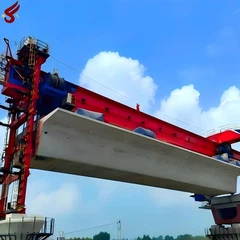
Hey there! As a supplier of Shipbuilding Gantry Cranes, I'm super stoked to dive into the hoisting mechanism of these bad - boys. So, what exactly is the hoisting mechanism of a Shipbuilding Gantry Crane? Let's break it down.
First off, let's understand what a Shipbuilding Gantry Crane is. It's a massive piece of equipment used in shipyards to handle heavy loads during the ship - building process. You can check out more about it Shipbuilding Gantry Crane. These cranes are like the giants of the shipyard, lifting everything from large steel plates to pre - fabricated ship sections.


The hoisting mechanism is the heart and soul of a Shipbuilding Gantry Crane. It's responsible for lifting and lowering the loads. There are a few key components that make up this mechanism.
The Motor
The motor is the power source of the hoisting mechanism. It provides the energy needed to lift the heavy loads. Most Shipbuilding Gantry Cranes use electric motors because they're reliable and can be easily controlled. The size and power of the motor depend on the maximum load capacity of the crane. For example, if a crane is designed to lift 500 tons, it will need a much more powerful motor than a crane that only needs to lift 50 tons.
The Gearbox
The gearbox is connected to the motor and plays a crucial role in the hoisting process. Its main job is to reduce the high - speed rotation of the motor to a lower, more usable speed for lifting the load. It also increases the torque, which is the force that makes the load move. Think of it like the gears in a car. When you're in a lower gear, you have more power to climb a hill, but you move slower. The gearbox in a hoisting mechanism works in a similar way, allowing the crane to lift heavy loads steadily.
The Drum
The drum is where the wire rope is wound. As the motor turns the gearbox, the gearbox turns the drum. When the drum rotates, it either winds the wire rope onto itself, which lifts the load, or unwinds the wire rope, which lowers the load. The size and shape of the drum are carefully designed to ensure that the wire rope winds and unwinds smoothly. A well - designed drum can prevent the wire rope from getting tangled or damaged, which is super important for the safety and efficiency of the crane.
The Wire Rope
The wire rope is what actually connects the crane to the load. It's made up of multiple strands of steel wire twisted together to form a strong and flexible cable. The wire rope needs to be able to withstand the weight of the load and the forces generated during the lifting and lowering process. Regular inspection and maintenance of the wire rope are essential to ensure its safety. If a wire rope shows signs of wear or damage, it needs to be replaced immediately.
The Hook
The hook is the part of the hoisting mechanism that attaches to the load. It comes in different shapes and sizes depending on the type of load it needs to lift. Some hooks are designed to lift flat objects, while others are used for lifting objects with a specific shape. The hook needs to be strong enough to hold the load securely and should be inspected regularly for any signs of damage or wear.
Now, let's talk about some of the different types of hoisting mechanisms that you might find in a Shipbuilding Gantry Crane.
Single - Speed Hoisting Mechanism
A single - speed hoisting mechanism is the simplest type. It has a fixed speed for both lifting and lowering the load. This type of mechanism is often used in smaller Shipbuilding Gantry Cranes or in situations where the load doesn't require precise speed control. It's easy to operate and maintain, but it may not be suitable for all applications.
Variable - Speed Hoisting Mechanism
A variable - speed hoisting mechanism allows the operator to adjust the lifting and lowering speed according to the requirements of the load. This is really useful when you need to lift a delicate or irregularly shaped load. For example, if you're lifting a large, fragile ship section, you can use a slower speed to ensure a smooth and safe lift. Variable - speed hoisting mechanisms are more complex than single - speed ones, but they offer greater flexibility and control.
Dual - Hoisting Mechanism
Some Shipbuilding Gantry Cranes are equipped with a dual - hoisting mechanism. This means that there are two separate hoisting systems on the crane. The dual - hoisting mechanism can be used to lift extremely heavy loads or to perform more complex lifting operations. For example, one hoist can be used to lift one end of a large load, while the other hoist can be used to lift the other end, allowing for better balance and control.
In addition to the Shipbuilding Gantry Crane, we also offer other types of gantry cranes. For instance, the MH Type Electric Hoist Gantry Crane is a popular choice for smaller industrial applications. It's more compact and easier to install compared to the Shipbuilding Gantry Crane. And if you're in the hydroelectric power station industry, our SDMQ Type Hydroelectric Power Station Gantry Crane is designed specifically to meet the unique requirements of that sector.
If you're in the market for a Shipbuilding Gantry Crane or any other type of gantry crane, we're here to help. Our team of experts can provide you with all the information you need to choose the right crane for your needs. We can also offer installation, maintenance, and repair services to ensure that your crane operates safely and efficiently.
Whether you're a small shipyard just starting out or a large, established ship - building company, we have the perfect solution for you. Don't hesitate to reach out to us to start a conversation about your crane requirements. We're eager to work with you and help you take your ship - building operations to the next level.
References
- Crane Design Handbook: A Guide to the Design of Overhead and Gantry Cranes
- Shipbuilding Industry Standards for Heavy - Lifting Equipment
So, if you're interested in learning more or making a purchase, feel free to get in touch. We're looking forward to hearing from you!