


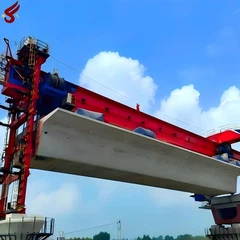


Product Introduction
Shipbuilding gantry cranes are core critical equipment in modern shipbuilding industry. They are specialized giant lifting machinery designed for large-scale hoisting, transportation, turnover, and joining operations of hull segments in docks, on berths, or platforms.
As a type of gantry crane, shipbuilding gantry cranes come in both single-girder and double-girder structural configurations. They are capable of performing various functions including single lifting, dual-hook coordinated lifting, in-air segment rotation, and precision horizontal positioning adjustments.
Product Parameter
|
Type(t) |
|
2x75 +75/20 |
2x100 +180/16 |
2x150 +150/30 |
2x175 +180/16 |
2x200 +350/50 |
|
Total Lifting Cap(t) |
200 |
350 |
450 |
500 |
700 |
|
|
Turning Over Cap(t) |
150 |
200 |
300 |
350 |
400 |
|
|
Working Duty |
A5 |
A5 |
A5 |
A5 |
A5 |
|
|
Span(m) |
S |
80 |
97 |
111 |
97 |
156 |
|
Lifting Height(m) Above Rail/Below Rail) |
H1 |
45/5 |
55/5 |
70/12.2 |
55/5 |
100 |
|
H2 |
45/5 |
55/5 |
70/12.2 |
55/5 |
100 |
|
|
H3 |
47 |
55/5 |
70/12.2 |
55/5 |
100 |
|
|
Max.working Load of Wheel KN |
480 |
420 |
520 |
530 |
550 |
|
|
Crane Rail |
QU80~QU120 |
|||||
|
Power Supply |
6~10kv |
|||||

Shipbuilding Gantry Crane
Product Feature And Application
Features of Shipbuilding Gantry Cranes:
Gigantic Scale: Features extremely high lifting capacity, wide span, and significant lifting height.
High Precision: Utilizes advanced technologies like frequency conversion, PLC control, and anti-sway systems to achieve precise positioning, meeting the stringent requirements of hull joining operations.
Multi-functionality: Through the flexible configuration and coordinated control of multiple trolleys and hooks, it can perform various complex processes such as lifting, tandem lifting, and segment turnover.
High Safety: The crane structure is robust and incorporates multiple safety protection systems, ensuring secure operation even in harsh industrial environments.
Application of Shipbuilding Gantry Cranes:
Shipbuilding gantry cranes are almost exclusively used in the following heavy industries:
Docks/Berths in Large Shipyards: This is their primary and most typical working environment. Here, the cranes perform the lifting, turning, and joining of hull segments.
Large Port Terminals & Heavy Machinery Manufacturing Plants: Used for loading, unloading, and transporting other overweight and oversized cargo or structural components, such as nuclear power modules and large bridge segments.
Ship Repair and Dismantling: In dry docks, they are used for hoisting large ship components for repair or to assist in vessel dismantling.
Product Details

|
|
Main Girder The "bridge" spanning over the ship dock, serving as the primary load-bearing structure of the crane, providing the runway for the trolley. Q235/Q345 carbon structural steel, Large span and high lifting capacity |
|
|
Travel Mechanism Composed of wheel assemblies / wheels and drive units, enabling the gantry (crane) / trolley to travel on the rails.
|
|
|
Maintenance Hoist A small, auxiliary crane installed to facilitate the maintenance of equipment on the main girder (e.g., the trolley, electrical cabinets). |
|
|
Trolley Typically includes an upper trolley and a lower trolley. They can operate independently or cooperatively to perform complex maneuvers such as lifting, tandem lifting, and segment turnover. |
|
|
Hook Multi hook lifting function to meet the complex shipbuilding process requirements |


Certification


Company Profile


FAQ
Q: What is a shipbuilding gantry crane?
A: A shipbuilding gantry crane is a specialized lifting device operating in shipyards at docks, berths, or platforms, specifically designed for the hoisting and turning over of hull sections. Its main characteristics are large lifting capacity, large span, and high lifting height.
Q: What are the structural forms of the main girder of a shipbuilding gantry crane?
A: There are mainly two forms: single main girder and double main girders.
Double Main Girders: Strong load-bearing capacity and good stability, but heavy self-weight and high cost.
Single Main Girder: Lighter self-weight, but maintenance space is relatively limited.
Q: Why are shipbuilding gantry cranes usually designed with one rigid leg and one flexible leg?
A: Because of their very large span. Adopting a structure with one rigid leg (fixed connection to the main girder) and the other flexible leg (connected via a flexible hinge to the main girder) can effectively release additional stress caused by temperature changes or load deformation, preventing structural damage.
Q: How are the upper and lower trolleys of a shipbuilding gantry crane coordinated?
A: They are typically equipped with two trolleys (upper and lower) working in coordination:
Upper Trolley: Equipped with two hooks of the same lifting capacity, which can be used separately or jointly for dual-hook lifting and rotating the workpiece.
Lower Trolley: Equipped with one main hook and one auxiliary hook. The main hook can work together with the two hooks of the upper trolley to achieve three-hook lifting and turning over in the air.
Q: What special operational functions does a shipbuilding gantry crane possess?
A: To meet the requirements of hull section construction technology, it possesses functions such as single lifting, dual-hook lifting, three-hook lifting, as well as turning over in the air and micro-rotation of hull sections. Hooks are also usually equipped with a transverse traversing mechanism to facilitate precise alignment during the assembly process.
Q: What are the key safety regulations for operating a shipbuilding gantry crane?
A: Key safety operations mainly include: conducting pre-operational inspections daily; strictly prohibiting overload and tilted lifting; strictly forbidding anyone to stand under the load; ceasing work in strong wind conditions; and returning handles to zero and cutting off power in case of a sudden power failure.