


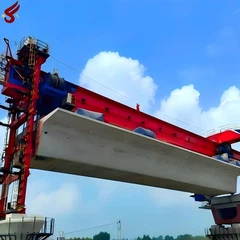
The main technical parameters of the overhead crane include lifting capacity, span, lifting height, running speed, lifting speed, working type and the energizing duration rate of the motor.
Lifting capacity
The lifting capacity, also known as the rated lifting capacity, refers to the actual maximum lifting load of the crane, which is measured in tons (t).
The lifting capacity of overhead cranes is 5, 10 (single hook), 15/3, 20/5, 30/5, 50/lO, 75/20, 100/20, 125/20, 150/30, 200/30, 250/30t (double hook) and so on. The numerator in the number lifts the weight with the main hook and the denominator lifts the weight with the secondary hook. For example, the 15t/3t crane means that the rated lifting capacity of the main hook is 15t, and the rated lifting capacity of the auxiliary hook is 3t.
Overhead cranes can be divided into three grades according to lifting capacity, 5~lOt is a small crane, lO~50t is a medium-sized crane, and more than 50t is a heavy crane.
Span
The span of the overhead crane refers to the distance between the center lines of the wheels at both ends of the crane girder, that is, the distance between the center lines of the cart tracks, in meters (m).
The span of the overhead crane is 10.5, 13.5, 16.5, 19.5, 22.5, 25.5, 28.5, 31.5m and so on. Every 3m is a grade.
Lift height
The distance between the upper limit position and the lower limit position of the spreader or grabbing device (such as grab, electromagnetic chuck) of the crane is called the lifting height of the crane and is measured in meters (m).
The commonly used lifting heights of cranes are 12, 16, 12/14, 12/18, 16/18, 19/21, 20/22, 21/23, 22/26, 24/26m and so on. Among them, the numerator is the lifting height of the main hook, and the denominator is the lifting height of the secondary hook.
Running speed
The running speed refers to the speed corresponding to the moving mechanism of the large and small cars when it drags the motor at the rated speed, and is measured in meters per minute (m/min). The running speed of the trolley is generally 40~60m/min, and the running speed of the trolley is generally 100~135m/min.
Lift speed
The speed at which the lifting mechanism lifts the weight at the rated speed, that is, the lifting speed. Generally, the lifting speed does not exceed 30m/min, which is determined by the nature, weight and lifting requirements of the weight.
The lifting speed also has an empty hook speed, which can reduce non-productive time, and the empty hook speed can be up to twice the rated lifting speed.
There is also a special case of lifting speed, the low speed when the heavy object is close to the ground, called the landing low speed, to ensure the safety of personal safety and the safety of goods, and its speed is generally 4~6 m/min.