




Product Introduction
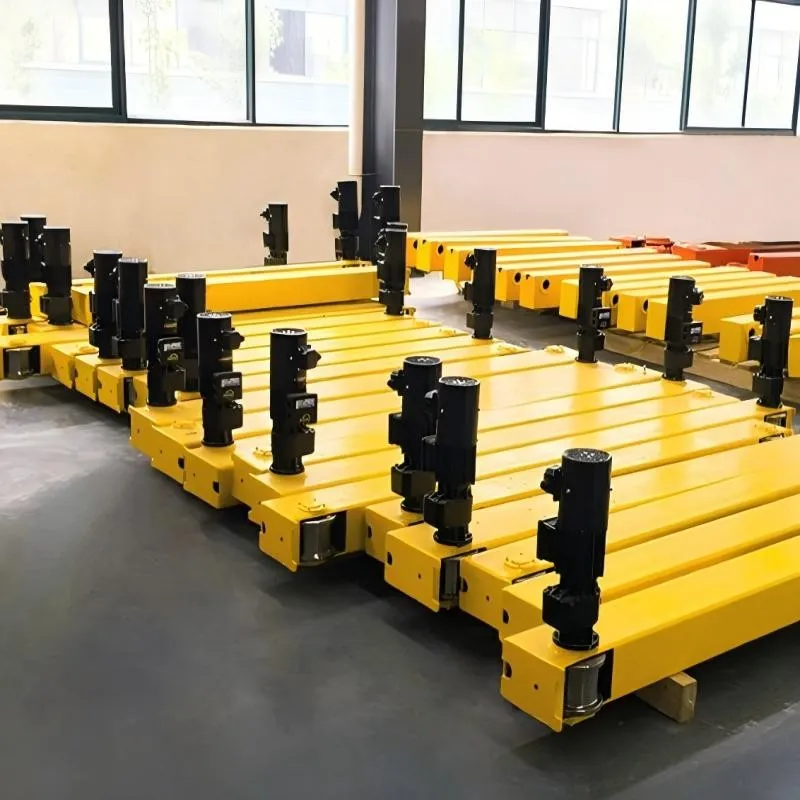
The European-style crane end carriage is the core component of the crane long-travel drive mechanism. Located at both ends of the main girder and connected to it, the end carriage carries and drives the entire crane to travel along the rails. The end carriage consists of wheel assemblies and an end beam frame; each end carriage is equipped with one driving wheel and one driven wheel. The main dimensions of the end carriage are determined by the span of the main girder, the crane wheelbase, and the trolley track gauge.
Yufei European-style crane end carriages are widely used in machinery manufacturing, automotive assembly, warehousing and logistics, and similar facilities. They are suitable for European-style single-girder overhead cranes and European-style double-girder overhead cranes.
Product Parameter
|
Parameter Category |
Parameter |
Typical Range / Specification |
|
Core Performance |
Lifting capacity |
1 t – 50 t |
|
Duty group |
Light (A1–A3), Medium (A4–A5) mainly |
|
|
Dimensional Specifications |
Span |
7.5 m – 31.5 m |
|
Wheel diameter |
< Ø250 (mostly rectangular tube structure); ≥ Ø250 (mostly welded steel plate structure) |
|
|
Wheel block model (common) |
LD150, LD200, LD300 |
|
|
Suitable rail type |
P24, etc. |
|
|
Traveling Performance |
Traveling speed |
4 – 45 m/min |
|
Drive System |
Motor power |
0.3 kW – 1.5 kW (depending on model) |
|
Protection rating |
IP55 |
|
|
Insulation class |
Class F |
|
|
Environmental Adaptability |
Operating temperature |
-25 °C to 40 °C |
Product Feature And Application
Features of the European-style crane end carriage
Compared with conventional single-girder crane end carriages and double-girder crane end carriages, European-style crane end carriages have the following characteristics:
Modular design, compact structure, small volume
Light self-weight and low wheel loads, which can reduce the construction cost of the workshop foundation
High dimensional accuracy, smooth travel, low noise
High transmission efficiency, low energy consumption, easy maintenance
Applications of the European-style crane end carriage
Suitable for European-style single-girder cranes and European-style double-girder cranes, it is widely used in industries with high requirements for space utilisation, operational accuracy, and energy saving/environmental protection, such as machinery manufacturing, warehousing and logistics, automotive, electronics, food, and pharmaceutical industries.
Product Details
|
|
End carriage frame: Fabricated from Q235B or Q345B steel, welded into shape using rectangular hollow sections or steel plates |

|
Drive system: Three-in-one geared motor, protection class IP55, insulation class F |
 |
Wheel assembly: Forged wheel assemblies are normally adopted; typical materials are 45# steel or 65Mn |

|
Safety devices: Rubber buffers at both ends, anti-derailment devices, rail sweepers; photoelectric limit switches are optional |

Certification


Company Profile


Packaging&Shipping


FAQ
Q: How are the dimensions of a European-style crane end carriage determined?
A: The main dimensions of the end carriage are determined based on the main girder span, crane wheelbase, and trolley track gauge.
Q: Can non-standard wheelbases, heights, or connection dimensions be customized?
A: Yes, full parameter customization is supported, including wheelbase, beam height, connection hole positions, and rail adaptation.
Q: Can a conventional crane be directly retrofitted with a European-style end carriage?
A: Yes. Simply measure the main girder connection dimensions and the rail parameters, then customize the corresponding interface. After the retrofit, performance improves significantly.
Q: How interchangeable are the spare parts for European-style end carriages?
A: They adopt an industry-standard modular design, and spare parts are interchangeable with those of mainstream brands, making procurement and replacement convenient.
Q: What does the routine maintenance of a European-style end carriage involve?
A: Inspection of wheel tread/flange wear, brake clearance and braking effectiveness, foreign objects on the rail, buffer integrity, and whether there is any abnormal noise or vibration during operation.