


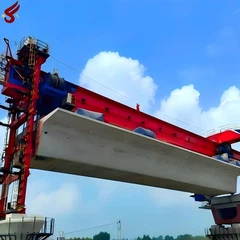
Hey there! As a supplier of floating cranes, I've had the pleasure of diving deep into the world of these amazing machines. In this blog, I'm gonna break down the key components of a floating crane, so you can get a better understanding of what makes them tick.


The Hull
Let's start with the hull. It's like the foundation of the floating crane, providing the necessary buoyancy and stability. The hull is designed to withstand the harsh marine environment, including waves, tides, and corrosion. It's usually made of steel, which is strong and durable. The size and shape of the hull depend on the crane's capacity and the intended use. For example, a large floating crane used for heavy - lift operations in deep waters will have a bigger and more robust hull compared to a smaller one used in shallower areas.
The hull also houses various systems, such as the ballast system. Ballast tanks are used to adjust the crane's stability and trim. By filling or emptying these tanks with water, the operator can ensure that the crane remains level and balanced during lifting operations. This is crucial because an unbalanced crane can be extremely dangerous and may lead to accidents.
The Crane Structure
The crane structure is the part that does the actual lifting. It's typically made up of a boom, a jib, and a mast. The boom is the long, horizontal arm of the crane that extends out over the water. It can be raised and lowered to adjust the lifting height. The jib is an additional arm that can be attached to the end of the boom, allowing for greater reach. The mast provides support for the boom and jib and is usually located at the center of the crane.
There are different types of crane structures, and one popular type is the Single Jib Portal Crane. This type of crane has a portal - like structure that allows it to move along a track on the hull. It's very versatile and can be used for a variety of lifting tasks, such as loading and unloading cargo from ships.
The Lifting Mechanism
The lifting mechanism is what enables the crane to pick up and move heavy loads. It usually consists of a winch, a wire rope, and a hook. The winch is a powerful motor - driven device that winds and unwinds the wire rope. The wire rope is attached to the hook, which is used to grab the load.
There are different types of lifting mechanisms, depending on the crane's capacity and the type of load it needs to lift. For example, a floating crane used for heavy - lift operations may have a hydraulic winch, which can provide more power and precision compared to an electric winch. Some cranes also use a multiple - drum winch system, which allows for simultaneous lifting and lowering of multiple loads.
The Control System
The control system is the brain of the floating crane. It allows the operator to control the movement of the crane, including the lifting, lowering, and slewing (rotating) of the boom. Modern floating cranes are equipped with advanced control systems that use sensors and computers to ensure accurate and safe operation.
The control system also includes safety features, such as overload protection. If the crane tries to lift a load that is too heavy, the overload protection system will automatically stop the lifting operation to prevent damage to the crane and ensure the safety of the operator.
The Power System
A floating crane needs a reliable power source to operate all its components. There are different types of power systems, including diesel engines, electric motors, and hybrid systems.
Diesel engines are commonly used because they are powerful and can operate independently of an external power source. They are also relatively easy to maintain. Electric motors, on the other hand, are more environmentally friendly and can provide smoother operation. Hybrid systems combine the advantages of both diesel engines and electric motors, offering a balance between power and efficiency.
Additional Equipment
In addition to the main components, a floating crane may also be equipped with other equipment, such as a Grab Ship Unloader or a Stacker - Reclaimer. A grab ship unloader is used to unload bulk cargo, such as coal or grain, from ships. It has a large grab that can scoop up the cargo and transfer it to a conveyor belt. A stacker - reclaimer is used to stack and reclaim bulk materials in a storage yard. It can move along a track and deposit or retrieve materials as needed.
Conclusion
So, there you have it! These are the key components of a floating crane. Each component plays a crucial role in the crane's operation, and they all work together to ensure safe and efficient lifting operations.
If you're in the market for a floating crane, whether it's for a small - scale project or a large - scale industrial operation, I'd love to have a chat with you. We've got a wide range of floating cranes with different capacities and features to meet your specific needs. Don't hesitate to reach out and start a conversation about your requirements. Let's work together to find the perfect floating crane solution for you.
References
- Marine Crane Handbook
- Crane Design and Operation Manuals